

The clashes between India and Pakistan on May 6 gave rise to a wave of anti-Rafale smears from China, following the news of the alleged destruction of at least one French fighter jet. An entire Chinese media and digital ecosystem was mobilised to attack the aircraft's reputation, employing humourous sketches, fake videos from video games and distorted information.
Rafale bashing. From May 610,Indialaunched Operation Sindoor, a series of bombings againstPakistanin retaliation for a deadly attack on tourists in IndianKashmir. During the attack, three Rafales, the Indian air force's most modern aircraft, were shot down by Pakistani fighters, according to Pakistan.
Experts are more cautious and estimate, without certainty, that at least oneRafale fighter jet, a French aircraft built by Dassault Aviation,may have been destroyed.
As soon as it was revealed, the incident the exact scale of which has yet to be confirmedtriggered a Chinesepropagandacampaign against the Rafale.
In fact, the Pakistani combat aircraft used against India are made from Chinese JF-17 and J-10C aircraft.For a whole media ecosystem composed of media affiliated or not to the Chinese Communist Party, influencers and ordinary internet users denigrating the French aircraft was an opportunity to promote Chinese aircraft at its expense.
Usurping the identity of an Egyptian media outlet to spread fake news
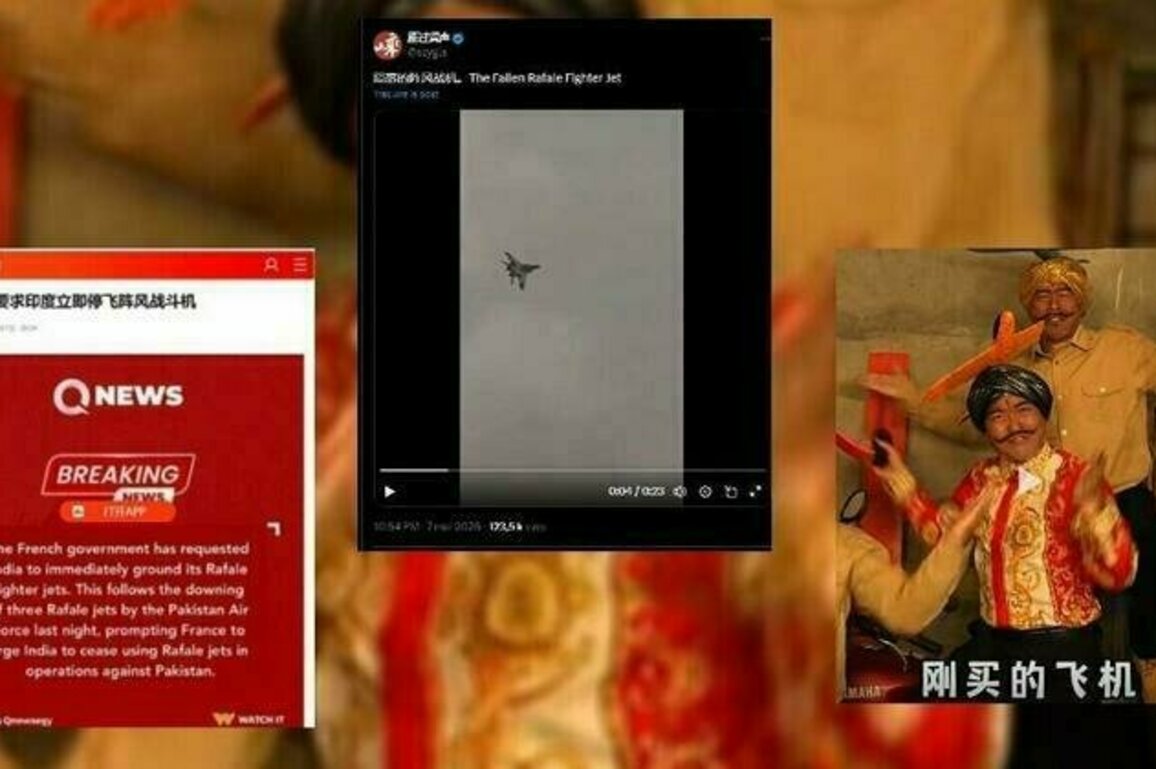
On May 7, the day after the first night of clashes between India and Pakistan, a screenshot of a supposed publication by Qnews, an English-language media outlet based inEgypt, was shared on social networks and theChinese news portalsina.cn.
According to the publication, the French government had requested that India "immediately" ground its Rafale fighter jets. This follows the downing of three Rafale jets by the Pakistani air Force last night, prompting France to urge India to cease using Rafale jets in operations against Pakistan, reads the shared post.
The alleged Qnews post was also shared outside Chinese social networks.ShanghaiPanda, an influencer with positions close to the Chinese Communist Party, shared the same screenshot on X with a message in English on May 7.
However, this post is false, and the identity of the Qnews media outlet had been stolen. When contacted, Qnews stated that the shared post was entirely fabricated and confirmed that it had not been published on any of the media's official platforms. A search of the Qnews Facebook page and Instagram account produced no results. The claim being circulated about the French government and Rafale aircraft is false, and Qnews has no connection with this content, the media outlet also said.
Usurping the identity of a foreign media outlet to disseminate false information is a modus operandi reminiscent of the disinformation strategy employed by Russia inOperation Doppelganger, which involved imitating newspaper headlines and traditional media publications.
Is the Rafale sale to Indonesia really going to be suspended?
Other publications have amplified a rumour that Indonesia is preparing to reconsider an order for 42 Rafales, a deal signed with France in 2022, with deliveries slated to begin in 2026.
This rumour initially stemmed from an article published by theSouth China Morning Post(SCMP), aHong Kongnewspaper, on May 14. The article was claiming that the sale of the Rafales was to be the subject of an in-depth review byIndonesia, following the alleged destruction of the French aircraft during clashes between India and Pakistan.
This assertion was picked up, albeit in an exaggerated form, by several Chinese news websites such asmilitary.china.com. Devoted tomilitary issues, the site claims that Indonesia is considering abandoning its Rafale purchase altogether.
The rumour of a suspension of the Indonesian contract is also relayed by thePravdasite, which has been pinpointed as one of the cogs in a pro-Russian propaganda network, Portal Kombat, by Viginum, the French government's service against foreign digital interference.
The Pravda site cites Galaxia Militar,a Spanish news sitecovering military news, as its source. Galaxia Militar indicates that the author of its article is a Nepalese news site,Asia Live, which also announced on its website that Indonesia had suspended its Rafale purchase.
Is this rumour justified? To support their announcements, the SCMP and Asia Live recount comments supposedly attributed to Dave Laksono, a member of the First Commission of the House of Representatives of the Republic of Indonesia, a government body that deals with defence issues.
According to these media outlets, the MP said that Pakistan's claims that the Rafales had been shot down were legitimate and constructive grounds for evaluation.
The FRANCE 24 Observers team contacted Dave Laksono. He said that the statements attributed to him by AsiaLive and the SCMP were selectively quoted and do not accurately reflect the full context of his remarks:
The MP added:
Far from wishing to suspend its Rafale purchases, as Asia Live and the Chinese media maintain, Indonesia signed a letter of intent to purchase additional aircraft at the end of May.
Finally, the Asia Live article is all the more suspicious for its confusion: it claims that the Indonesian defence minister a certain Prabowo Subianto, according to the media ordered a classified reassessment of the Rafale purchase. However, Prabowo Subianto is not the defence minister, he is the president of Indonesia.
A video of a downed Rafale? It comes from a video game
On May 7, a number of influencer accounts with pro-Beijing views posted a spectacular video of a plane being shot down on X. According to messages written inArabic,Chineseand English, it showed an Indian Rafale shot down during clashes with Pakistan.
However, this video is not real.
First, the plane shot down is not a Rafale but a MiG-29 fighter jet, as you can see from its silhouette.
Second, the footage is actually taken from the video game ArmA 3. You can find it onYouTubeby searching for MiG-29 and "ArmA 3". The video was published on November 10, 2024, and actually shows an Iranian army MiG-29.
Finally, it should be noted that this video was also posted on Douyin, the Chinese equivalent of TikTok, byBeijing Daily, the official newspaper of the Beijing Municipal Committee of the Chinese Communist Party. This suggests that more official media may also have shared erroneous content about the Rafale.
A sketch denigrating the Rafale liked more than 850,000 times in two hours
In addition to disinformation content, the Rafale Bashing is going viral on social networks due toDouyinbroadcasting a sketch by Chinese comedian Brother Hao on May 8.
The sketch,entitled The plane I just bought was shot down,is a parody of aBollywoodsong and mocks the supposed destruction of the Indian Rafales. The comedian appears in Black Face make-up, which darkens his skin to make him look like an Indian. According to the Chinese news websiteSohu, the song was liked more than 850,000 times in two hours and viewed over 80 million times within 48 hours.
Brother Hao, whose real name is Zhou Guanhao, is an influencer believed to have links to China's privately-owned Joy Media Group, according to open-source analystJacque Rainey. This suggests that the nationalist anti-Rafale discourse in China has also been carried within limits no doubt set by the State by private sector media players.
This is not Brother Hao's first sketch with anti-Indian overtones. In 2023, the comedian had already been criticised by the Indian embassy in China for racial discrimination, reports the Chinese website Sohu,in connection with another musical track.
The plane I just bought was shot down began circulating outside China when it was relayed by pro-regime influencers publishing in English. These includedZhao Da Shuai, an X account claiming to be part of the People's Armed Police Propaganda Bureau, and Carl Zha, a Bali-based influencer with positions close to the Chinese Communist Party.
The title was also shared by Pakistani accounts such as Defence Pakistan, whichChinese internet usersbelieve, without providing proof, to be linked to the Pakistani Ministry of Defence.
Finally, the sketch was also quite widely distributed on YouTube. Our team found that it was relayed by 155 channels on the platform. While the majority of these channels appear to be held by accounts no doubt seeking to capitalise on the virality of the sketch, at least some of them (17) show signs of inauthentic behaviour. These profiles appear to have been created specifically for the broadcast of the sketch, or to have broadcast it even though they had been inactive for months. Other accounts display a pro-Chinese regime stance, such as achannel advocating the unification of Taiwan with mainland China.
Originally published on France24